

We’ve always known that food affects our health—but now, people are acting on that knowledge in more intentional ways. Whether it’s managing chronic conditions or simply feeling better day to day, more individuals are turning to food as a tool for wellness. That shift is fueling the rise of culinary nutrition, a field that blends the science of what to eat with the skills to make it delicious and accessible.
Sound interesting?
This guide explores what culinary nutrition is, what professionals in the field do, and how to build a career within it. Whether you’re a culinary professional looking to expand your impact, a nutrition practitioner who wants to develop your skills in the kitchen, or someone drawn to the relationship between food and health, understanding the landscape is the first step toward finding your place within it.
What Is Culinary Nutrition?
Food has always been central to human health. But the fields responsible for understanding that relationship—nutrition science and culinary arts—have largely developed in parallel, with nutrition research in labs and cooking in kitchens. Culinary nutrition is what happens when those two worlds come together.
At its core, culinary nutrition is the practice of applying nutritional science directly to the art and craft of cooking. It draws on food science, health and wellness principles, and professional culinary technique to create meals that taste good and actively support the health of the people they’re prepared for.
More Than Healthy Eating
It’s tempting to think of culinary nutrition as simply “cooking healthier food,” but that framing does a disservice to what the field actually involves. Culinary nutritionists understand how ingredients and the human body interact, and how certain cooking methods can preserve or destroy micronutrients, how macronutrient ratios affect energy and satiety, and how the same dish might need to be modified depending on who’s eating it.
That depth of knowledge enables a kind of precision that general healthy cooking can’t offer. A culinary nutritionist working with someone managing type 2 diabetes isn’t only cutting out sugar, they’re also identifying sources of refined carbohydrates, selecting ingredients that support blood sugar stability, and preparing them in ways that consider nutritional impact and palatability. This ability to tailor food to the specific health needs of individuals and families is one of the defining characteristics of culinary nutrition, and one of the reasons it’s increasingly valued across healthcare, wellness, and foodservice settings.
Cooking as Preventative Medicine
A helpful way to better understand culinary nutrition is to think of it as cooking as a means of preventative medicine. Chronic diseases, such as obesity, diabetes, and heart disease, are all linked, at least in part, to diet—and many can be prevented or better managed with the right nutritional interventions. Culinary nutrition uses food as an active, practical tool for improving health.
This is what sets the field apart. It’s not restrictive or dependent on following rigid dietary rules. Instead, it’s about understanding food deeply enough to use it wisely, optimizing what goes on the plate, educating people about what they’re putting in their bodies, and ultimately making healthy eating something people can sustain and enjoy.
What Does a Culinary Nutritionist Do?

Nutrition science can tell us a great deal about what we should eat. But knowing that dietary fiber supports gut health and reduces the risk of chronic diseases is very different from knowing how to turn that insight into a meal someone will actually enjoy. That gap between nutritional knowledge and the plate is where culinary nutritionists work.
Their role is to translate the principles of nutrition science into real, practical, delicious food. The difference between a dietitian advising a patient to “eat more fiber” and a culinary nutritionist is that the latter can walk into a kitchen and show them how to make a high-fiber, three-bean chili that’s hearty, flavorful, and easy enough they can prepare it themselves on any weeknight. That combination of nutritional knowledge and culinary skill is what makes the role uniquely valuable.
Common Responsibilities
While the day-to-day work of a culinary nutritionist varies depending on where they work and who they serve, most share a common set of responsibilities:
- Menu design: Developing meal plans and menus that meet specific nutritional goals without compromising on flavor, variety, or cultural relevance
- Recipe development: Creating and testing recipes that are both nutritious and genuinely appealing to the people who will be eating them
- Nutrition education: Teaching individuals, families, or groups about the nutritional value of different foods, how to read labels, and how to make informed choices at the grocery store
- Culinary instruction: Demonstrating cooking techniques that preserve nutritional value, improve the health profile of a dish, or make healthy cooking more accessible and approachable
- Behavior support: Helping people build sustainable, healthy eating habits by addressing the practical, emotional, and cultural factors that shape how and what we eat
- Food sourcing and sustainability: Understanding where ingredients come from, how they are produced, and how sourcing decisions affect both nutritional quality and environmental impact
Culinary Nutritionist vs. Registered Dietitian
While these two roles share common ground, they are distinct in their scope of practice, credentials, and the kind of work professionals are licensed to do. Understanding the difference is important, especially when planning for a career in the field.
Registered Dietitians
Registered dietitians (RDs), also known as culinary dietitians, are licensed healthcare professionals trained to assess individual medical needs, interpret laboratory results, and provide evidence-based nutrition therapy. Their scope of practice is defined and protected by law, which means they are authorized to diagnose nutrition-related conditions, prescribe therapeutic diets, and manage cases involving illness, disease, or recovery.
In clinical settings, an RD might develop a specialized meal plan for a patient recovering from surgery, manage the nutritional care of someone with kidney disease, or interpret bloodwork to adjust a client’s dietary protocol. Their work is grounded in scientific training and governed by professional licensure requirements that vary by state.
Culinary Nutritionists
Culinary nutritionists occupy a different, but equally important, space. Rather than diagnosing or prescribing, their focus is on translating nutritional principles into healthy, practical, and enjoyable meals. They bring a deep understanding of nutrition science into the kitchen, using culinary skills to make nourishing food accessible for the people they serve.
Where a dietitian might determine that a patient needs to reduce saturated fat intake, a culinary nutritionist knows how to make that change taste good, and can redesign a favorite recipe, demonstrate a new cooking technique, or build an entire menu around that goal without sacrificing flavor or satisfaction.
This distinction in scope doesn’t mean one path is superior to the other. Instead, the two roles work best as complements to each other. For example, in integrative health settings, hospitals, and wellness programs, RDs and culinary nutritionists might collaborate, with one providing the clinical framework and the other bringing it to life in the kitchen.
Overlap With Culinary Therapy
Culinary nutrition also intersects with culinary therapy, a closely related field that applies nutrition and culinary principles within a more clinical, long-term care framework. While culinary nutrition focuses on translating nutrition science into practical, health-supportive meals, culinary therapeutics often takes a broader, more individualized approach—developing structured meal plans, supporting behavior change, and addressing ongoing health conditions over time.
Practitioners in culinary therapeutics may also work more directly within healthcare or research settings, using evidence-based strategies to support patient outcomes and, in some cases, contributing to the growing body of research around food-based interventions. Together, culinary nutrition and culinary therapeutics reflect an increasingly integrated approach to health that not only considers what people eat, but how food can be used strategically to support long-term wellbeing.
Careers in Culinary Nutrition
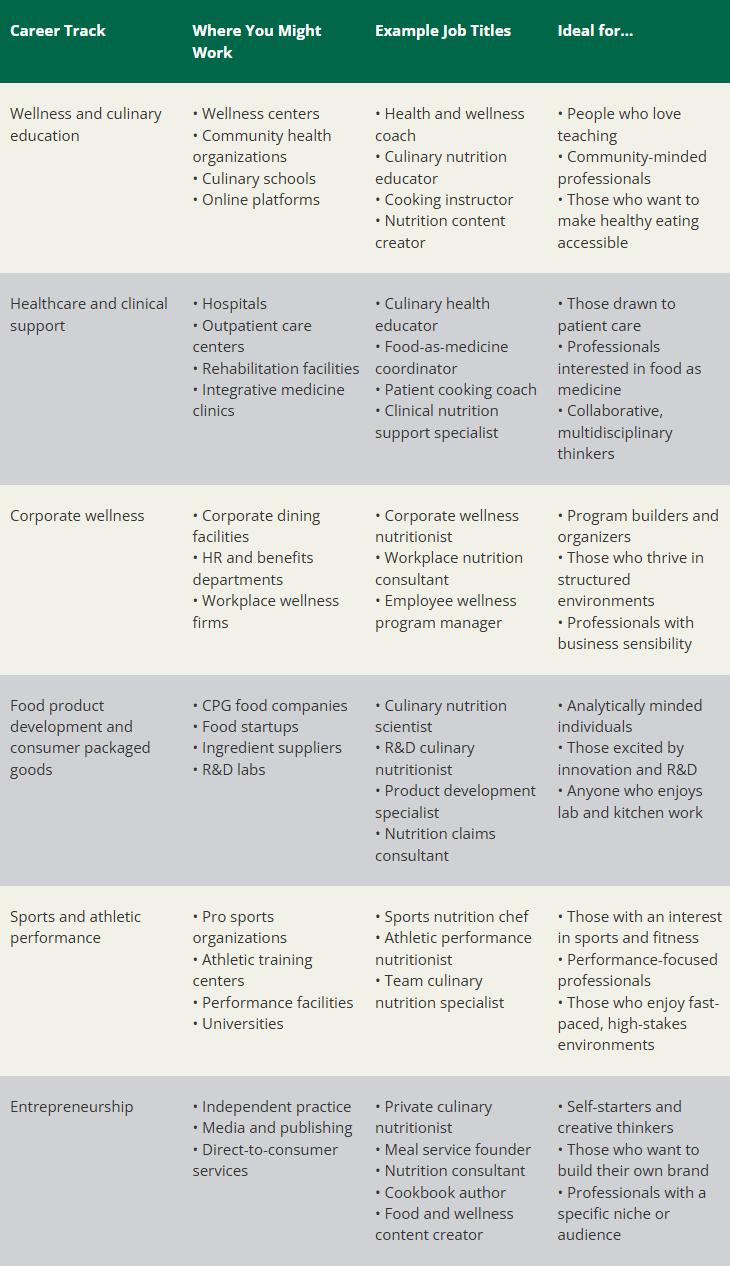
One of the most compelling aspects of culinary nutrition as a field is the breadth of directions it can take you. Because food and health intersect across so many industries and contexts, professionals with a background in culinary nutrition are needed in settings that range from hospitals and corporate campuses to food startups, professional sports organizations, and beyond. Below is a look at some of the career tracks available to culinary nutrition professionals.
Wellness Coaching and Culinary Education
Many culinary nutritionists build careers centered on teaching and empowerment, helping individuals, families, and communities develop the knowledge and skills to eat well on their own terms. In this track, you might work as a health and wellness coach, culinary instructor, or nutrition educator, leading demonstrations, developing curriculum, or guiding clients through the practical side of forming healthier eating habits. These roles are found in community health organizations, wellness centers, culinary schools, and even in online and content-driven platforms.
Healthcare and Clinical Culinary Support
As the connection between diet and chronic disease becomes better understood, hospitals, integrative medicine practices, and outpatient clinics are expanding their approach to patient care to include culinary support. In these settings, culinary nutritionists work alongside physicians, registered dietitians, and other healthcare providers to help patients implement dietary changes that are both medically appropriate and culinarily achievable. Roles might include culinary health educator, patient cooking coach, or food-as-medicine program coordinator, positions that work at the intersection of clinical care and hands-on culinary instruction.
Corporate Wellness and Workplace Food Programs
Employers are beginning to recognize the relationship between employee nutrition and workplace performance, and many are investing in programs that reflect that understanding. Culinary nutritionists in this space might design menus for corporate cafeterias, develop nutrition education initiatives for employee wellness programs, or consult with organizations on how to improve the nutritional quality of the food available to their workforce. It’s a growing area that blends public health sensibility with a practical, workplace-focused approach.
Food Product Development and CPG
Consumer demand for nutritious, clean-label, and functionally beneficial food products is high, and food companies are responding. Culinary nutritionists who are drawn to the product development side of the industry can find roles supporting R&D teams at consumer packaged goods companies, ingredient suppliers, and food startups. In these positions, they help ensure that new products are both nutritionally sound and tasty, bringing a sensory and culinary perspective to formulation decisions that purely scientific teams may lack. This track pairs naturally with the skills of a research chef, and professionals who develop expertise in both areas are particularly well-positioned within the CPG space.
Sports and Athletic Performance
Elite athletic performance is closely tied to nutrition, and culinary nutritionists are finding roles within professional sports organizations, training facilities, and performance centers to support that connection. In this track, professionals develop performance-focused meal plans, educate athletes on fueling strategies, and prepare or oversee the preparation of food designed to support training, recovery, and competition. It’s a highly specialized area that rewards both deep nutritional knowledge and the ability to make high-performance eating practical and enjoyable.
Entrepreneurship: Meal Services, Consulting, and Content
For culinary nutritionists with an entrepreneurial spirit, the field offers opportunities to build their own businesses. Some launch personalized meal prep or delivery services tailored to health goals or dietary needs. Others establish independent consulting practices, working with individual clients, healthcare providers, or food businesses. Still others build platforms in content and media—writing cookbooks, developing recipe content, producing videos, or growing an audience around a specific nutritional philosophy or culinary approach. The combination of credibility, culinary skill, and health knowledge that culinary nutrition professionals bring is well-suited to the growing consumer appetite for trusted, accessible food and wellness content.
Career Comparison Chart
Here’s how these tracks stack up:
Education Pathways: Certificate vs. Bachelor’s vs. Master’s
There is no single entry point into culinary nutrition. The field attracts people from a variety of backgrounds—trained chefs who want to deepen their understanding of nutrition science, nutrition and dietetics graduates who want to develop practical culinary skills, and career changers drawn to food and health from entirely different fields. The right educational path depends on where you’re starting from, what you want to do, and how far you want to go.
Here’s a breakdown of the three primary education levels and what each one offers.
Certificate Programs
Certificate programs in culinary nutrition are typically short-form, focused credentials designed to build foundational knowledge quickly. They’re best suited for professionals who already have a base in either culinary arts or nutrition science and want to add competency in the other direction (e.g., a working chef who wants to understand how to apply nutritional principles to their cooking, or a nutrition professional who wants to develop their kitchen skills).
What they cover: These programs generally cover core topics such as nutrient-dense cooking techniques, ingredient substitution, basic dietary principles, and menu planning for specific health needs. They’re a useful credential for someone looking to add culinary nutrition to an existing practice or resume without committing to a full degree program.
Who they’re best for: Certificate programs are a strong fit for career changers seeking an accessible entry point, culinary professionals looking to expand into wellness-oriented cooking, and healthcare or nutrition practitioners who want to incorporate hands-on food preparation into their work.
What to keep in mind: Because they tend to be narrower in scope, certificate credentials are most effective when combined with prior professional experience or a related degree. On their own, they may limit advancement potential in more specialized or clinical roles.
Looking to Improve Your Skills and Get Insight Into the Workings of the Professional Kitchen?
Gain the culinary knowledge to bring your passion for food and desire for career growth together with CIA’s Accelerated Culinary Arts Certificate Program (ACAP). Explore the program.
Bachelor’s Degrees
A bachelor’s degree provides a more comprehensive foundation, blending culinary technique, nutrition science, food studies, and often business or communication training into a multi-year program. This is the most common pathway for students who are entering the field without experience in either culinary arts or nutrition, as it builds both areas of expertise from the ground up.
What they cover: Strong bachelor’s programs don’t require students to choose between cooking and science; they integrate both. Students develop professional culinary skills alongside coursework in food chemistry, human nutrition, dietary planning, and food systems. Many programs also include internships that place students in professional environments before graduation.
Who they’re best for: This path is well-suited for students entering directly from high school or who are early on in their careers, culinary professionals who want a structured, credential-backed transition into nutrition-focused work, and nutrition or health science graduates who want to develop serious culinary competency alongside their existing knowledge.
What to keep in mind: A bachelor’s degree opens doors across the full range of career tracks covered in the previous section. It also provides the academic foundation needed to pursue graduate study.
Prepare to Leave a Lasting Impact Through Food
Whether you’re interested in a career as a culinary nutritionist or one within the culinary arts, CIA’s undergraduate degree programs provide the skills, knowledge, and experience to make a difference. Explore undergraduate degrees.
Master’s Degrees
A master’s degree is the highest level of formal education in culinary nutrition, and it’s designed for professionals who want to move into leadership, clinical, research, or highly specialized roles.
What they cover: Graduate programs go beyond foundational knowledge to explore the deeper science behind food and health, examining how nutrition intersects with disease management, therapeutic intervention, food policy, and systems-level thinking.
Who they’re for: At this level, students are typically expected to arrive with relevant prior education or professional experience. That might mean a culinary professional with years of industry experience and a bachelor’s degree in a related field, or a registered dietitian or healthcare provider who wants to develop clinical culinary expertise. The common thread is that graduate students bring something substantive to build on, with the program deepening and sharpening that foundation rather than building it from scratch.
What to keep in mind: Master’s-level credentials unlock advanced career opportunities in the field: leadership roles in clinical food-as-medicine programs, research and policy positions, academic appointments, and senior roles in product development or corporate wellness. For professionals who want to shape the culinary nutrition field, graduate education is the natural next step.
Master the World of Food and Beverage
From Culinary Therapeutics to Food Business, choose the professional master’s degree that fits your goals. Explore graduate degrees.
What to Look for in a Culinary Nutrition Degree Program
Not all culinary nutrition programs are created equal. Because the field draws from two distinct disciplines, the quality of the program depends on how well it integrates both and how seriously it prepares students for the realities of working in food and health environments.
When evaluating programs, keep an eye out for ones that include:
- Scientific depth and an evidence-based curriculum: Culinary nutrition is grounded in science, and the best programs reflect that. Look for a curriculum that goes beyond surface-level nutrition guidelines to engage with food chemistry, human physiology, dietary assessment, and the evidence base behind nutritional interventions. A program that treats nutrition as a set of general principles instead of a scientific discipline will leave graduates underprepared for roles where that depth matters.
- Hands-on application: Knowledge of nutrition science only goes so far without the ability to apply it to food. Strong programs balance classroom and lab learning with substantial time in professional kitchens, test kitchen environments, or real-world implementation settings. Look for programs that treat culinary skill as a serious academic discipline and provide regular opportunities for students to apply what they’re learning.
- Faculty expertise and industry partnerships: The quality of a program is shaped, in part, by the instructors. Faculty who bring firsthand experience in culinary nutrition bring a level of practical insight that purely academic instruction can’t replicate. Industry partnerships matter too: connections to the places that culinary nutritionists work expand the learning environment beyond the classroom and signal that a program is embedded in the professional world students are preparing to enter.
- Career support, capstone work, and networking: A strong program invests in students’ futures. Look for structured career support, including advising, job placement resources, and alumni networks that give graduates a well-connected community to lean on. Capstone projects, practicums, or thesis work that engage real-world problems are also a positive indicator. They signal that a program expects students to absorb information, as well as apply it, defend it, and make a meaningful contribution before they leave.
Want to learn from and work with nutritionists, culinary therapists, and healthcare professionals working at the forefront of the field?
The annual Food is Life, Food is Health summit brings together chefs, physicians, nutrition scientists, and sustainability experts for a gathering dedicated to transforming the future of personal and planetary health. Co-sponsored by the Culinary Institute of America and the Stanford Center for Continuing Medical Education, the summit offers continuing education credits alongside opportunities to deepen your skills and expand your knowledge.
Why Earn a Master’s in Culinary Therapeutics?
For culinary professionals who want to move beyond the kitchen and into the future of preventative health, a master’s degree is an opportunity to make that change. CIA’s Master’s in Culinary Therapeutics is built on the premise that culinary expertise, when combined with deep nutritional and therapeutic knowledge, can become a powerful tool for improving health.
The program is designed for culinary and foodservice professionals who want to apply their craft in health-forward, therapeutic, and performance-oriented settings. Instead of a nutrition degree with cooking added on, this program takes culinary experience as its starting point and builds a rigorous framework of nutritional science, evidence-based dietary theory, and wellness systems thinking around it.
Applicants are expected to arrive with a bachelor’s degree and culinary or foodservice experience, whether that comes from an undergrad culinary arts degree, a professional certificate program, or extensive hands-on kitchen work. From that foundation, the program advances students into territory that most culinary training never reaches: therapeutic meal planning, nutrition and optimal diet theory, health and wellness systems integration, and the behavioral science of how people actually change the way they eat.
What Sets This Program Apart
Several features of the Culinary Therapeutics master’s program distinguish it from other graduate programs in food and nutrition:
- A culinary-first approach to food as medicine: Where many nutrition programs treat cooking as a secondary skill, this program treats it as the primary lens. Students learn to approach food as medicine through a chef’s perspective, developing the ability to translate clinical nutritional goals into delicious meals that people actually want to eat.
- Online format with immersive in-person residencies: The program is delivered online over two years, making it accessible to working professionals without requiring a full relocation. It is supported by three short in-person residencies at CIA’s campuses in New York’s Hudson Valley and California’s Napa Valley, where students gather for hands-on kitchen work, sensory and palate development, and visits to healthcare settings and wellness centers.
- A capstone grounded in real-world impact: The program culminates in a capstone project developed with the guidance of faculty advisors and mentors. This is an opportunity for students to apply everything they’ve learned to a substantive, original challenge in their area of focus.
- Faculty who practice what they teach: CIA’s graduate faculty bring firsthand experience from clinical nutrition, culinary science, and food-as-medicine practice. That expertise shapes classroom learning and how subject matter is taught—ensuring that the program reflects the realities of the field.
Where It Can Take You
Culinary therapeutics is an emerging field with numerous career possibilities, and the program prepares graduates for a wide range of advanced roles, spanning areas from healthcare-based foodservice in hospitals and rehabilitation centers to performance nutrition for athletes, private and corporate R&D chef positions, wellness and spa programming, and educational roles in schools and universities. For culinary professionals ready to step into leadership at the intersection of food and health, it offers a credential and a community that is difficult to find anywhere else.
FAQs
What is the meaning of culinary nutrition?
Culinary nutrition is the practice of applying nutritional science to the art of cooking, using culinary skill and ingredient knowledge to create food that actively supports health and wellbeing. It bridges the gap between what we know about nutrition and what actually ends up on the plate, combining evidence-based dietary principles with the practical craft of preparing food that is nourishing, delicious, and suited to the specific needs of the people eating it.
What is a culinary nutrition course?
A culinary nutrition course is a structured program of study that integrates nutrition science with hands-on culinary training. Depending on the level and focus, a course might cover topics like nutrient-dense cooking techniques, ingredient functionality, dietary planning for specific health conditions, food chemistry, menu design, and behavioral approaches to supporting healthy eating. Culinary nutrition courses are available at several levels—from short certificate programs and continuing education workshops to full degree programs at the bachelor’s and master’s levels.
What is the highest-paying job in culinary nutrition?
Earning potential in culinary nutrition varies depending on specialization, setting, level of education, and experience. That said, professionals who combine advanced credentials—such as a master’s degree in culinary therapeutics—with deep industry experience and a clearly defined area of expertise are generally best positioned for the upper end of the salary range.
How can I become a culinary nutritionist?
There is no single, fixed path to becoming a culinary nutritionist, but most professionals build their careers through some combination of culinary training, nutrition education, and hands-on experience. A strong foundation typically begins with either formal culinary education or a degree in nutrition, dietetics, or a related health science. Certificate programs can provide a focused entry point for those already working in one field who want to add competency in the other. Bachelor’s degree programs in culinary science or food studies offer a more integrated foundation for those earlier in their careers. For professionals seeking advanced roles in clinical, research, or leadership settings, a master’s degree provides both the depth of knowledge and the credential to support that next step.
Promote Wellness Through Our Culinary Therapeutics Program
Build your nutritional and culinary knowledge and technique through this innovative and online master’s program.
Related posts:

Learn more about CIA’s Culinary Therapeutics master’s degree.
Ready to take the next step?
Inquire now or apply today.
